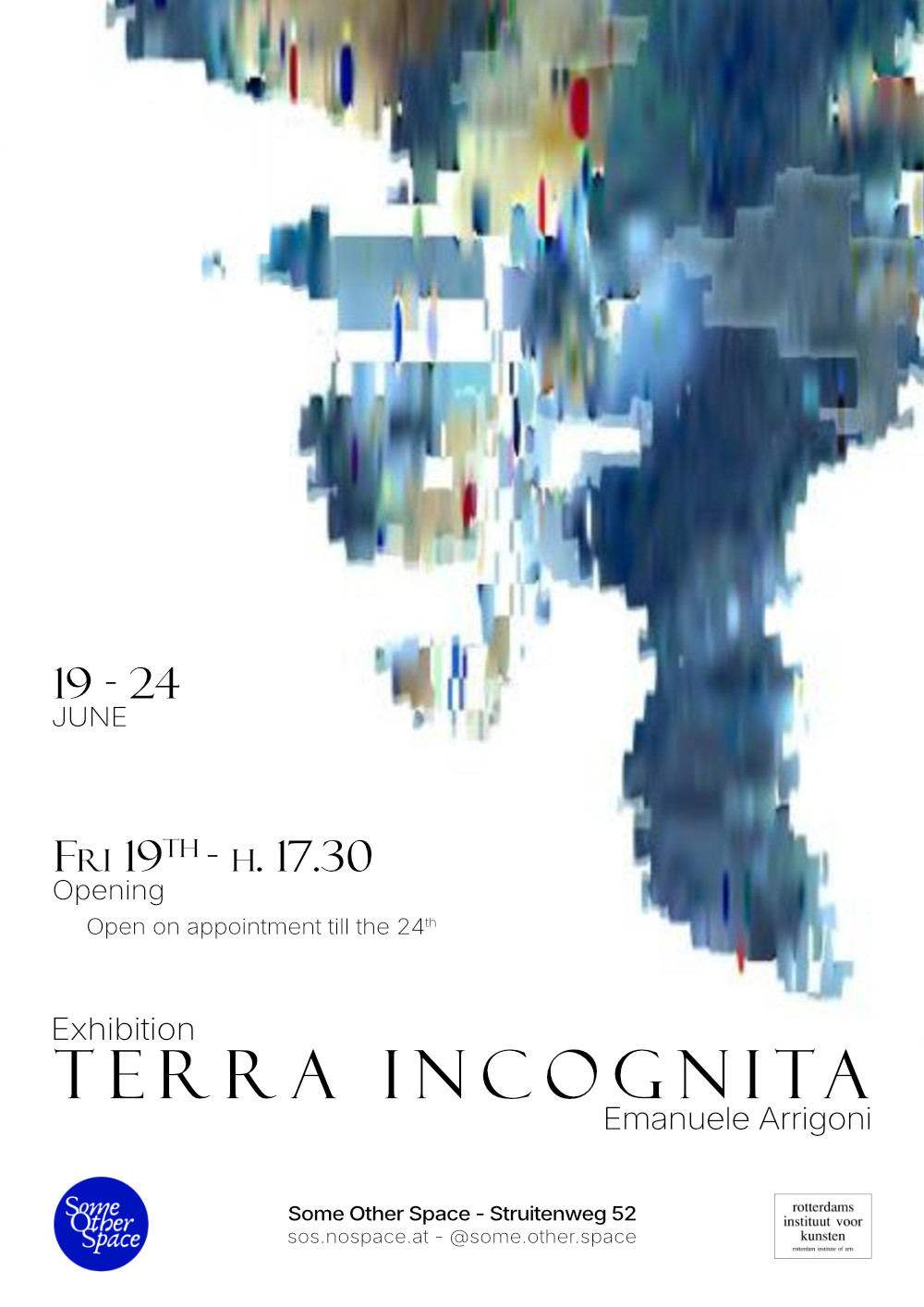
Terra Incognita
With this term, 16th century maps demarcated the cartographic boundary between the known and the mysterious, between what has been explored and what has not yet been grasped by an anthropocentric vision. Just as Ortelius' Theatrum Orbis Terrarum attempted to contain the chaos of geography within rational grids, today’s satellite images repeat the same gesture with a rhetoric of omniscience. Terra Incognita exploits the ambiguous potential of satellite photography to reveal how much mystery and uncertainty still endure in the age of data, the apparent dominance of reality by technology.
Following exactly the actions of a photographer, Arrigoni proposes a series of post-photographic works. He reframes and extrapolates clippings from the great satellite map of the world, where each image presented becomes an enigma: glaciers and deserts are transformed into abstract canvases, geological forms challenge perceptions of scale. Terra Incognita transforms the viewer into an explorer of a territory that is both very concrete (it exists in the physical world) and radically elusive (it escapes categorisation), leading him to question the real existence of what we are looking at, and consequently on what basis we build our own certainties.
The images in this series are presented without alterations, a choice that echoes Flusser's lesson: if technical images are products of apparatuses (satellites, software, sensors), their presumed objectivity already conceals an original manipulation. Visual artefacts - compression errors, colour distortions, algorithmic geometries - are not imperfections, but symptoms of a realness inherent in the nature of the digital medium.
As Virilio states, ‘seeing at a distance is not seeing’: the satellite's zenith perspective, instead of clarifying, multiplies the questions. The accumulation of data does not return a real experience of proximity, but generates a mediated and detached vision, incapable of restoring an authentic relationship with the observed territory. Left in their natural state, the images express a refusal to adhere to the paradigm of digital transparency and instead become the bearers of a critical awareness that highlights their limits, inviting the spectators to reflect on the way in which they constructs their own visual and cognitive certainties.
Each map thus carries within it the ghost of its own failure. Satellite images, which yearn to be mirrors of reality, instead reveal their nature as constructs: what we call “factual” is always the result of a negotiation between light, sensors, binary codes and human interpretation. In an age where the simulacrum replaces the referent, these images escape Baudrillard's logic of “more real than real”. They show neither truth nor fiction, but the liminal zone where the two registers collide, inviting us to rediscover the mystery and ambiguity of representation, where their apparent “purity” is immediately revealed as the sign of a complexity irreducible to the logic of control and transparency.
The result is an archaeology of the future: these images, although rooted in the technological present, anticipate a world in which the distinction between natural and artificial will be definitively obsolete. What makes them disturbing is not their otherness, but our sudden awareness that we already inhabit that limbo. Terra Incognita does not map places, but the psyche of an age that, despite having the tools to decipher everything, must reinvent the art of getting lost.
Program
- 17:30 - 20:00
- Exhibition opening
- Exhibition open on appointment.
Write us an email
Or send a DM to
@some.other.space
@emanuele.arrigoni
June 19th - Friday
June 20th - 24th
Info
Emanuele Arrigoni (Italy, 1999) is a multidisciplinary artist and researcher, he works in the cracks of media as well as theory and practice.
Through the use of hacker practices, he explores the potential, limitations, failures and breaking points of technology.
He adopts an inquisitive approach seeking to uncover possible unconventional perspectives on the subject of his
investigation, where technology serves as a meta-tool to investigate the meta-level of technology’s own interference.
Website Emanuele Arrigoni
Instagram @emanuele.arrigoni